 anmol.gakhar
Choosing the right Zoho partner can make the difference between a CRM that simply gets installed
and a business system that actually improves how your team works.
For most businesses, Zoho implementation involves much more than creating user accounts and configuring a few
fields. A successful project may involve CRM setup, process mapping, customization, workflow automation,
integrations, data migration, reporting, user training, and ongoing support. The partner you choose needs to
understand both the technology and the way your business operates.
This becomes especially important when you're evaluating providers across different markets. A Zoho partner in the USA, UAE, or India may offer different combinations
of technical expertise, availability, pricing, industry experience, and support.
So how do you identify the best Zoho partner for your business?
The answer isn't simply to choose the company with the most certifications or the lowest quote. You need to evaluate their implementation experience, technical capabilities, understanding of your business processes, communication, project methodology, and ability to support you after launch.
How to Choose the Best Zoho Partner?
The best Zoho partner is one that combines proven Zoho expertise with a clear understanding of your business
processes, technical requirements, industry, and long-term goals.
Before hiring one, evaluate their experience with Zoho CRM or Zoho One, customization and integrations, data
migration, automation, training, project management, communication, pricing, and post-launch support. Ask for
relevant implementation examples and make sure the partner can explain how they will turn your existing workflows
into a practical Zoho solution.
What Does a Zoho Partner Actually Do?
A Zoho partner helps businesses plan, configure, customize, implement, and maintain Zoho applications around
their specific operational requirements.
Simply purchasing Zoho doesn't automatically give you a well-designed CRM or business automation system.
Someone still needs to determine how the system should be structured and how it should interact with your existing
processes and software.
A typical Zoho implementation partner may help with:
- Discovery and requirements gathering: Understanding your sales, marketing, finance, support, and operational processes.
- Business process analysis: Identifying inefficient or manual processes that can be improved through Zoho.
- Zoho CRM setup: Configuring modules, fields, layouts, roles, profiles, pipelines, and other CRM components.
- Customization: Adapting Zoho applications to business-specific workflows and requirements.
- Workflow automation: Automating repetitive tasks, notifications, approvals, assignments, and follow-ups.
- Integrations: Connecting Zoho with accounting software, websites, communication tools, payment systems, marketing platforms, or other business applications.
- Data migration: Moving customer, sales, product, or other business data from spreadsheets or another CRM.
- Testing: Checking workflows, integrations, permissions, automations, and data before launch.
- Training: Helping employees understand how to use the system effectively.
- Deployment: Moving the configured system into production with minimal disruption.
- Ongoing support: Troubleshooting issues and helping the system evolve as your business changes.
A good partner should therefore act as more than a technical installer. They should help translate your business requirements into a workable Zoho environment.
Why Choosing the Right Zoho Partner Matters?
A poorly planned implementation can create problems that become expensive to fix later.
For example, imagine a company that implements Zoho CRM without properly mapping its sales process. Sales
representatives may end up with unnecessary fields, confusing pipelines, duplicate records, and workflows that
don't match how they actually sell.
The software isn't necessarily the problem. The implementation is.
Choosing the right Zoho consulting partner can help you avoid:
- Low user adoption
- Poor CRM configuration
- Duplicate or inconsistent data
- Broken automations
- Unnecessary customization
- Integration problems
- Confusing reporting
- Delayed implementation
- Higher long-term costs
- Poor return on your Zoho investment
The goal shouldn't be to customize everything. It should be to create a system that supports your business without making it unnecessarily complicated.
15 Factors to Consider When Choosing a Zoho Partner
There are many Zoho consultants in the market, but they aren't all suited to the same type of project. Use the following criteria to evaluate potential partners.
1. Zoho Expertise and Certifications
Start by checking the partner's experience with the Zoho products you actually plan to use.
Certifications or official partner status can provide useful signals, but they shouldn't be your only
evaluation criterion.
Ask:
- Which Zoho products do you specialize in?
- How many implementations have you completed?
- What type of projects have your consultants handled?
- Do you have experience with complex CRM or Zoho One deployments?
The objective is to establish whether their claimed expertise matches your project requirements.
2. Relevant Industry Experience
A partner doesn't necessarily need to specialize exclusively in your industry, but experience with similar
business models can reduce the learning curve.
For example, a B2B company with a long sales cycle may have very different CRM requirements from a retail
business.
Ask: "Have you implemented Zoho for businesses with processes similar to ours?"
Look for examples that demonstrate how the partner solved actual business problems rather than simply listing client names.
3. Experience With Businesses of Similar Size
A Zoho implementation for a five-person company can look very different from one involving multiple departments
and hundreds of users.
Your partner should understand the complexity appropriate to your organization.
Consider:
- Number of users
- Number of departments
- Multiple locations
- Approval structures
- Reporting requirements
- Data volume
- Integration requirements
A partner experienced with organizations of similar scale is more likely to anticipate implementation challenges.
4. Zoho CRM Implementation Experience
If Zoho CRM is central to your project, ask specifically about previous CRM implementations.
Don't settle for "Yes, we work with Zoho CRM."
Ask how they approach:
- Sales pipelines
- Lead management
- Assignment rules
- Data structure
- Workflow automation
- Reporting
- Permissions
- Lead conversion
- Custom modules
A strong Zoho CRM implementation should reflect how your team actually operates.
5. Zoho One Implementation Capabilities
Zoho One can involve multiple applications across departments.
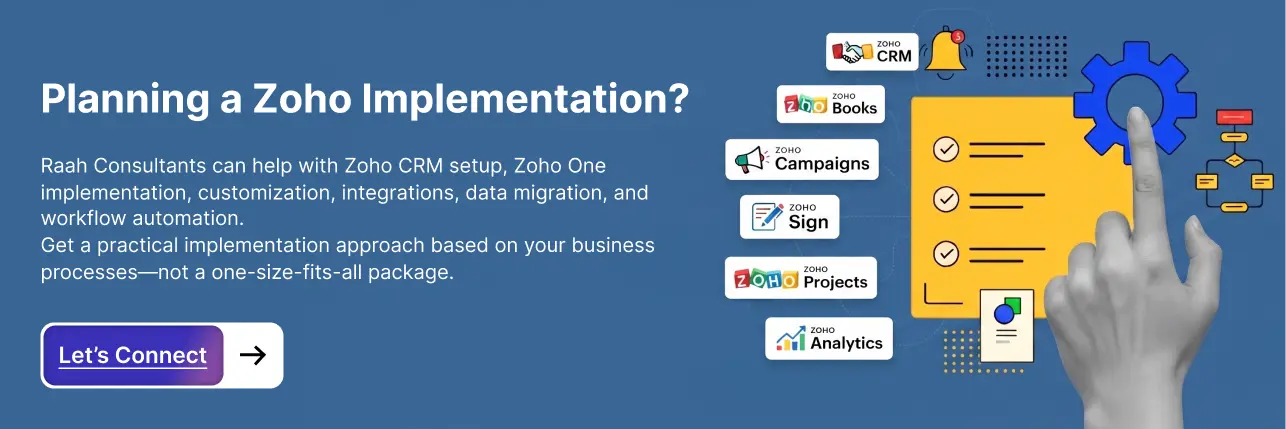
A partner helping with a Zoho One implementation should understand how applications such as CRM, Books,
Inventory, Desk, Projects, Analytics, Creator, Flow, and Campaigns can work together where relevant.
Ask: "Can you design an implementation across multiple Zoho applications rather than treating each application as a separate system?"
This matters if your long-term objective is business-wide automation rather than just CRM deployment.
6. Customization Expertise
Out-of-the-box functionality may not cover every business requirement.
A capable Zoho consultant should know when customization makes sense—and when it doesn't.
Excessive customization can make a system harder to maintain.
Ask: "How do you decide whether to use native Zoho functionality, configuration, automation, or custom development?"
The answer can tell you a lot about the partner's implementation philosophy.
7. Integration Capabilities
Your CRM rarely exists in isolation.
You may need Zoho to communicate with:
- Accounting platforms
- Websites
- Marketing systems
- Payment platforms
- ERP systems
- Communication tools
- Communication tools
Ask the partner to explain how they would approach your specific integration requirements.
A good integration strategy should consider data flow, authentication, synchronization, error handling, and
ownership of the integration.
8. Data Migration Experience
Moving data into Zoho isn't simply a matter of uploading a spreadsheet.
Data may contain:
- Duplicate records
- Missing information
- Incorrect formatting
- Inconsistent naming
- Old or unused records
- Relationships between different datasets
Ask: "How do you audit, clean, map, test, and migrate our existing data?"
A clear migration methodology is particularly important if you're moving from another CRM.
9. Automation and Workflow Expertise
Automation is one of the major reasons businesses invest in CRM platforms.
A good partner should be able to identify repetitive processes that can be automated without creating
unnecessary complexity.
Examples may include:
- Lead assignment
- Follow-up reminders
- Approval workflows
- Notifications
- Customer onboarding
- Internal task creation
- Sales alerts
- Data synchronization
Ask for examples of automations they've implemented and the business problem each one solved.
10. Clear Project Methodology
A professional implementation should have a defined process.
While methodologies vary, you should understand how the partner handles:
- Discovery
- Requirements
- Solution design
- Configuration
- Customization
- Integration
- Data migration
- Testing
- Training
- Deployment
- Post-launch support
If a partner wants to begin configuration immediately without understanding your requirements, that's worth questioning.
11. Communication and Availability
Communication can become a major issue in international projects.
When evaluating a Zoho partner in the USA, UAE, or India, consider:
- Working hours
- Time-zone overlap
- Meeting availability
- Response times
- Project communication channels
- Escalation procedures
- Primary point of contact
Technical expertise doesn't compensate for consistently poor communication.
12. Training and Onboarding
A technically successful implementation can still fail if employees don't know how to use the system.
Ask what training is included and whether it covers different user roles.
For example, sales representatives may need different training from administrators or managers.
A good onboarding plan should help users understand not only where to click, but also how the new system
changes their daily workflow.
13. Post-Implementation Support
Your relationship with a Zoho partner shouldn't necessarily end when the system goes live.
Your business will change. New users may join. Processes may evolve. Integrations may need updates.
- What support is available after launch?
- Is support included in the project?
- Are support plans available?
- What are the response times?
- What are the response times?
- Can the partner help with future enhancements?
Ongoing support can be particularly valuable for businesses using Zoho as a core operational platform.
14. Pricing Transparency
Don't compare partners solely on the final project price.
A low initial quote may exclude important services such as migration, training, integrations, testing, or
support.
Ask for a breakdown of:
- Scope
- Deliverables
- Implementation services
- Custom development
- Integration work
- Migration
- Training
- Support
- Additional charges
The cheapest proposal isn't necessarily the most cost-effective one.
15. Case Studies and Client Results
Ask potential partners for relevant case studies.
Look for evidence of:
- Similar business challenges
- Similar Zoho applications
- Comparable implementation complexity
- Measurable improvements
- Long-term client relationships
Specific examples are generally more useful than generic claims about being "experienced."
How to Choose a Zoho Partner in the USA?
For businesses in the United States, choosing a Zoho partner in the USA or an international partner should come
down to project requirements rather than geography alone.
Consider:
Time-Zone Coverage
If your team needs frequent meetings or rapid support during US working hours, make sure the partner can provide sufficient overlap.
Business Process Experience
Ask whether the partner has worked with businesses that have similar sales, customer service, finance, or operational workflows.
Integration Requirements
US businesses may have complex technology stacks. Your partner should be able to assess how Zoho will fit into the systems you already use.
Scalability
Don't evaluate the implementation only for today's requirements. Ask how the proposed architecture will support additional users, processes, integrations, and reporting needs.
Communication
Establish who your primary contact will be and how project updates, issues, and decisions will be communicated.
An international partner can be an excellent choice if it provides the technical expertise, communication,
support
coverage, and project management your business needs.
How to Choose a Zoho Partner in India?
Businesses evaluating a Zoho partner in India have access to a broad pool of technical and implementation
expertise.
But cost shouldn't be the only consideration.
Evaluate:
- Zoho product expertise
- CRM and Zoho One experience
- Technical customization capabilities
- Integration experience
- Data migration methodology
- Availability of consultants
- Communication
- Project management
- Training
- Long-term support
Indian Zoho consultants can also be a practical option for businesses operating internationally when there is
sufficient time-zone overlap and a well-defined communication process.
The right question isn't "Which partner is cheapest?"
It's "Which partner can deliver the required outcome at a reasonable total cost?"
Local vs. International Zoho Partner: Which Is Better?
There is no universal winner between a local and international Zoho partner.
| Factor | Local Partner | International Partner |
| Geographic familiarity | Often strong | Depends on experience |
| Time-zone alignment | Usually easier | Needs to be evaluated |
| Technical talent | Varies | Varies |
| Industry expertise | Depends on specialization | Can offer broader experience |
| Communication | Often convenient | Depends on support model |
| Cost | Varies | Varies |
| Scalability | Depends on team size | Depends on team size |
| Support | Evaluate availability | Evaluate availability |
The better choice depends on your project.
If local knowledge and same-day communication are critical, a local partner may make sense. If specialized
technical expertise or broader implementation experience is more important, an international partner may be worth
considering.
Evaluate the capability of the specific partner, not just their location.
How Much Does Zoho Implementation Cost?
There isn't one standard Zoho implementation price because the scope can vary significantly from one business to
another.
The cost may depend on:
- Number of users
- Zoho applications involved
- CRM complexity
- Customization
- Integrations
- Data migration
- Workflow automation
- Reporting requirements
- Training
- Ongoing support
For example, configuring a relatively straightforward Zoho CRM environment is fundamentally different from
implementing Zoho across CRM, finance, inventory, customer support, analytics, and multiple integrations.
When comparing proposals, look beyond the headline number.
A partner offering a lower price may have excluded services that another partner has included. Compare the
scope, deliverables, methodology, support, and expected outcomes rather than hourly rates alone.
How Raah Consultants Can Help?
Choosing a Zoho partner is ultimately about finding a team that understands both your business and the technology
required to support it.
Raah Consultants helps businesses with Zoho-focused consulting and implementation requirements,
including:
- Zoho CRM setup
- Zoho CRM implementation
- Zoho One implementation
- Zoho customization
- Zoho integration services
- Data migration
- Workflow automation
- Zoho consulting
- User training
- Ongoing support
The right implementation approach starts with understanding your current processes, identifying what needs to
change, and then designing the Zoho environment around those requirements.
If you're evaluating Zoho for your business or considering an existing CRM migration, discuss your
requirements with Raah Consultants before deciding on the implementation approach.
Final Takeaway
Choosing the best Zoho partner isn't about finding the company with the biggest list of services or the lowest
quote.
It's about finding a partner that can understand your business, design an appropriate Zoho architecture,
execute
the implementation carefully, communicate clearly, and remain available as your requirements evolve.
Whether you're evaluating a Zoho partner in the USA, UAE, India, or another market, use the same core
principle:
evaluate capability, experience, methodology, communication, and long-term value - not geography or price alone.
A well-planned Zoho implementation can become an important foundation for sales, operations, customer
service,
finance, and business automation. The right partner helps make that investment work for your business rather than
simply getting the software live.
Frequently Asked Questions
A Zoho partner helps businesses plan, configure, customize, integrate, migrate, and support Zoho applications. Depending on the project, this can include Zoho CRM setup, automation, data migration, training, and ongoing consulting.
Evaluate the partner's Zoho expertise, relevant industry experience, implementation track record, customization and integration capabilities, project methodology, communication, pricing transparency, training, and post-implementation support. Ask for relevant examples before hiring.
Certification or official partner status can be useful when evaluating expertise, but it should not be the only deciding factor. Look at actual implementation experience, technical capabilities, project methodology, client results, and support.
Zoho implementation costs vary according to factors such as the number of users, applications, customization, integrations, data migration, automation, reporting, training, and support. Compare detailed scopes rather than relying only on the total project price.
Implementation timelines depend on project complexity. A straightforward CRM setup may require significantly less work than an implementation involving extensive customization, integrations, data migration, automation, and multiple departments.
The best way to establish a realistic timeline is to complete a proper discovery and requirements assessment first.
Yes. Data migration can be part of a Zoho implementation. A partner may help with data assessment, cleaning, field mapping, transformation, migration, validation, and testing.
Yes, depending on the systems involved and the available integration methods. A Zoho partner can assess your existing technology stack and determine how data should move between systems.
If you're implementing several Zoho applications or automating processes across departments, working with an experienced Zoho consultant can help you plan the overall architecture and avoid disconnected application setups.
A Zoho consultant typically focuses on advising, configuring, customizing, or implementing Zoho solutions. A Zoho partner may provide a broader range of official or specialized Zoho services. The exact scope depends on the provider, so evaluate the actual services and experience they offer.
Many Zoho consulting companies offer post-implementation support, maintenance, troubleshooting, enhancements, and additional consulting. Confirm the available support model, response times, and pricing before signing the implementation agreement.